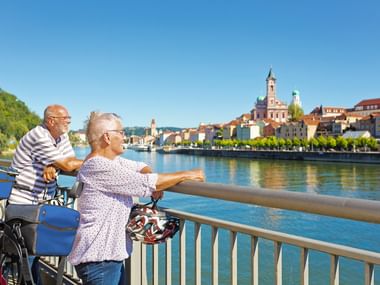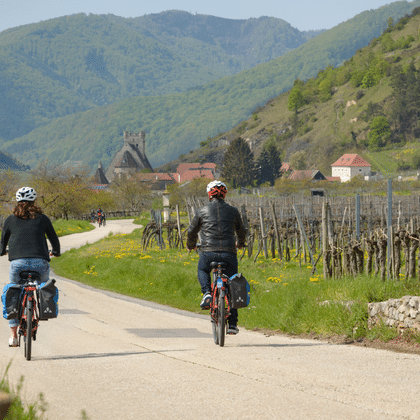

The Danube is one of Europe’s most famous rivers, and for good reason. It connects cities, landscapes, and cultures, offering countless ways to experience them: from the sun deck of a river cruise ship, from the saddle of a bicycle along the Danube Cycle Path, or on a stroll through one of the many towns along its banks.
It is precisely this diversity that makes the Danube so special to us. It is varied, easily accessible, and ideal for trips that combine culture, nature, and relaxation. Why do we love the Danube so much? There are many reasons.
Because it guides the way
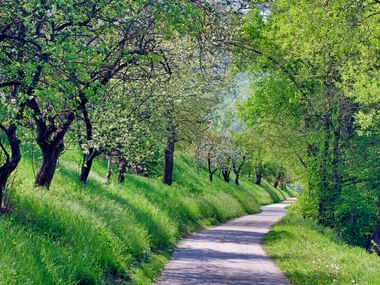
On our bike & boat trips along the Danube, it becomes especially clear why this river is such a perfect travel companion. The route follows the natural course of the river - for example, from Passau or Engelhartszell to Vienna and back again. During the day, we bike along the banks of the Danube, passing through small towns, river landscapes, and famous stretches like the Schlögener Schlinge or the Wachau. In the evening, the ship awaits at the next dock, once again becoming the familiar starting point for the next day’s journey.
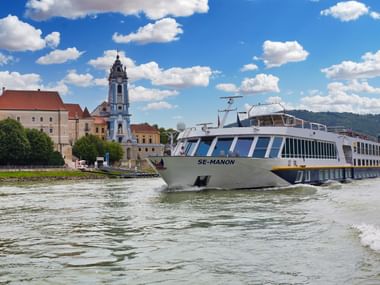
It is precisely this combination that makes the trip so enjoyable: the Danube sets the course, the ship travels along with it, and the individual stages come together quite naturally. Whether aboard the MS SE-MANON departing from Passau or the MS PRINZESSIN KATHARINA departing from Engelhartszell, the river remains the common thread throughout the entire journey. The result is a well-organized trip that still leaves plenty of room for your own discoveries.
Because in summer it tastes of apricots
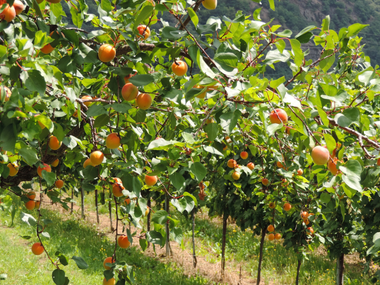
There is plenty to see along the Danube, but also plenty to taste. In the Wachau, apricots are an essential part of summer. Alongside wine, they are one of the region’s best-known specialities. The unique climate between the Danube, the Waldviertel and the Pannonian Basin provides sunny, warm days, cool nights and the distinctive aroma that makes Wachau apricots so popular.
Around harvest time in July, apricots can be found throughout the Wachau: at roadside stalls, directly from local producers, at festivals or as a classic feature on restaurant menus. Sometimes they are served as jam on bread, sometimes as apricot dumplings, juice, cake or compote. Those travelling along the Danube at the right time of year can therefore experience the region not only through its scenery, but also through its flavours.
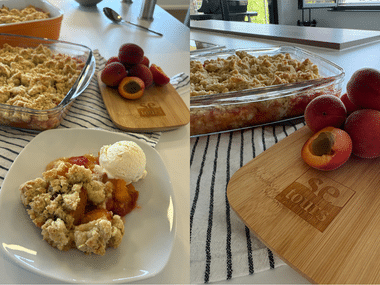
To match the season, we recently brought a little piece of Danube summer into our office. Together, we prepared an apricot crumble with vanilla ice cream for our colleagues. It was a simple idea, but one that shows how closely travel and regional specialities can sometimes be connected. After all, anyone who experiences the Danube does not just take away memories of landscapes, cities and cycle paths, but often a very particular taste as well.
Recipe: Our apricot crumble with vanilla ice cream
Ingredients for about five to six servings
For the apricot filling, you will need 1 kg apricots, about 35 g sugar, 1 tbsp cornflour, the juice of one small lemon and 1 packet of vanilla sugar or 1 tsp vanilla extract.
For the crumble topping, you will need 135 g flour, 85 g cold butter, 65 g sugar and a pinch of salt. If you like, you can also add about 35 g oats.
Preparation
Wash the apricots, halve them, remove the stones and cut them into rough pieces. Then mix them with the sugar, lemon juice, vanilla and cornflour and place the mixture in an ovenproof dish.
For the crumble topping, rub the flour, cold butter, sugar and salt together with your hands until crumbly. Spread the crumble evenly over the fruit. Bake at 180 °C top and bottom heat for about 25 to 30 minutes, until the crumble is golden brown. Serve warm with vanilla ice cream.
Briefly explained: Marille or apricot?
Both are correct. In Austria, South Tyrol and parts of Bavaria, people usually say Marille, while in many other regions of Germany the fruit is called Aprikose. It is the same fruit, but the name changes depending on the region.
The history of the apricot goes back a long way. It was already cultivated in China more than 4,000 years ago. From there, it spread via Central Asia to Europe. Recent research suggests that apricots reached today’s Danube countries early on, travelling along the Danube region.
Fruit growing also has a long tradition in the Wachau. The special climate along the Danube and the experience of local fruit growers have helped make the region one of Europe’s best-known apricot-growing areas. The Wachau apricot stands for quality, origin and a flavour that is closely linked to summer on the Danube.
Our conclusion: Whether you call it Marille or apricot, with crumble topping and vanilla ice cream it tastes delicious either way.
Because it connects cities, states, and landscapes
The Danube makes it easy to experience a wide variety of sights in a short amount of time. This is especially evident on our bike & boat tours to Budapest. Depending on the tour, the route begins in Passau or Engelhartszell and continues through Austria, Slovakia, and Hungary all the way to the Hungarian capital.
Along the way, well-known cities like Vienna, Bratislava, and Budapest alternate with quieter river landscapes. Sometimes the route takes you through the Wachau region with its vineyards and small villages; other times, through the Danube floodplains or the Hungarian “Danube Bend.” It is precisely this mix that makes the Danube so special: it connects major cultural cities, scenic stretches, and different countries into a journey that remains varied without becoming overwhelming.
Because it makes cycling trips especially enjoyable
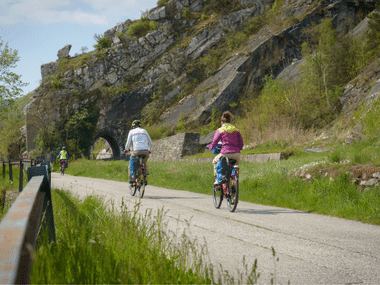
The Danube Cycle Path is one of the most famous bike routes in Europe. The section between Passau and Vienna is particularly popular because it combines many of the elements that make for a great cycling trip: easy-to-ride routes, varied landscapes, small towns, culture, and frequent views of the Danube.
Many sections are virtually flat and are therefore particularly well-suited for leisure cyclists. That’s exactly what makes the Danube such a perfect fit for our bike-and-boat tours. During the day, you cycle along the river; in the afternoon or evening, the boat awaits you once again as a floating hotel. This allows you to actively explore the region without having to arrive at a new destination every day.
The Schlögener Schlinge, the Wachau, Vienna, or even continuing on toward Bratislava and Budapest all demonstrate just how varied the Danube Cycle Path can be. You’re on the move, yet still have time for breaks, scenic views, and discoveries along the way.
Our conclusion: The Danube remains diverse
Whether by bike, aboard a ship, or on a trip to one of the many cities and regions along the river: there are so many different ways to experience the Danube. That’s exactly what makes it so special to us. It combines nature and culture, activity and relaxation, well-known destinations, and small moments of pleasure.
Perhaps that’s why we love the Danube so much: because it’s never just one thing. It’s a bike path, a waterway, a cultural landscape, a region of culinary delights, and a travel companion all at once. And anyone who’s ever traveled along or on the Danube quickly understands why this river has been one of Europe’s most popular travel destinations for so many years.
If you’d like to experience the Danube for yourself, our bike & boat tours and river cruises offer various ways to get to know this special river.